
Sound is present everywhere: in the rhythm of your breath and heartbeat; and in the movement of the sea, air and earth. In the same breath, space is not silent. Although sound needs a medium and cannot travel through a vacuum, gas and plasma around stars, galaxies and black holes can carry pressure waves. There is a primal vibration that classical yoga system sees as underpinning existence. Sound and silence may appear opposite, yet both arise within a deeper field of awareness that this yogic sound represents.
Sound emerges from silence and, when it fades, silence takes its place. In yogic wisdom, AUM is not merely a sound. It is understood as the deeper reality in which both sound and silence exist. But the ordinary mind experiences the world through opposites. It sees sound as one thing and silence as another. Because of this dualistic way of perceiving, the deeper reality beyond both can be difficult to recognize directly. The ancient scriptures therefore offer this primordial sound as a simple support for meditation.
Yoga of inner resonance calls this subtle dimension of sound as “nada” and AUM is regarded as its most fundamental expression. The primal vibration is a traditional way of gradually turning away from the outer worlds of sounds and sensations and becoming aware of the inner source of sound and silence. It is a complete and shortest mantra contemplated as encompassing the whole of existence. Instead of remaining engaged with outer sounds, thoughts and distractions, you begin to observe what is happening within.
DEEPER ESSENCE
When the human mind cannot understand the language of silence, how can it be expected to perceive that which lies beyond both sound and silence? For this reason, the ancient yogic tradition uses AUM as a simple expression of that which cannot be fully grasped through ordinary language. The totality of speech and existence is represented through three Sanskrit sounds—A, U, and M.
The Taittiriya Upanishad speaks of Om in relation to Brahman, the supreme truth. In this understanding, the mantra sound does not merely name something within existence; it points toward the reality underlying the whole of existence—beyond the ordinary limitations of time, space and direction. It becomes more than a word or a sound to be repeated. It becomes a symbol of the totality of existence and a doorway to that which cannot be completely expressed in words.
DISTINCT QUALITIES
This primordial vibration is traditionally experienced through three sounds—A, U, and M. Each sound has a different quality and can be understood as a gradual shift of awareness from the external world toward the inner space. The sound becomes a support for letting go of old mental patterns and attachments that binds you to this world.
The opening sound “A” breaks the stillness and brings your attention inward. As you chant it with devotion, you begin to feel its pleasing vibration within body that helps you become more aware of your breath, body, thoughts and inner state. The practice is not about forcing anything. It is simply about becoming more aware of what is happening within you.
“U” continues the vibration and carries it into a subtler experience. As the sound flows, your attention can move deeper within. The constant feeling of “me” and “mine” may begin to lose its grip. When you remain fully connected with the sound, you are not merely repeating a word. You are listening to the vibration and observing your own inner world.
The syllable “M” brings the sound mantra toward its completion. The vibration gradually becomes subtle and finally dissolves into silence. Now, instead of doing, you simply watch and remain aware. The mind may become quieter, and a sense of witnessing can arise—the ability to observe thoughts and experiences without identification.
OPENING TO THE DIVINE
You may not yet know that reality. You may not have had a direct spiritual experience of it. But you can close your eyes, and chant this mantra devotionally. It becomes a simple way of offering your practice to something supreme than your limited self. It reminds you that you are not separate from the vastness of existence—you are also a part of it.
Chanting helps silences the talkative mind and gather scattered attention. In yoga and spiritual practice, it serves as a traditional salutation, reminding the practitioner of the deeper reality underlying existence. Chanting at the end of a yoga or spiritual practice helps you gently carry the inner stillness of the practice back into ordinary activity.
There are many paths to reconnect with the higher self, and yogic wisdom gives each path its own name and method. Whether it is hatha Yoga, ashtanga Yoga or kundalini Yoga, aum is traditionally chanted at the beginning and end of practice. This chanting is more than a ritual. It is a traditional salutation to the source from which existence arises.
POWER OF SOUND
Sound has power, and science recognizes that sound and vibration can produce physical effects. A familiar example is soldiers being asked to break step while crossing a bridge, because synchronized rhythmic marching can create repeated forces that may cause dangerous vibrations in certain structures.
Just as rhythmic sound of walking by a unit of soldiers can create powerful vibrations in a bridge, AUM uses sound and vibration as a support for awareness. At first, attention rests on the sound produced by the body. Gradually, awareness shifts to the vibration and the practice moves from doing toward simply observing.
The mind needs something to hold on to. When it finds nothing steady, it keeps jumping from one thought to another. By fixing the mind on the “aum” sound, you give it a single point to rest upon. But the sound alone is not enough. Devotion, commitment and dedication make the practice meaningful and help the mind stay connected with the sound.
Gradually, scattered thoughts become quieter, attention becomes steadier, and awareness turns inward. In AUM chanting, sound is used more consciously. When the syllable is pronounced correctly, with prolonged “M” sound, the gentle humming vibration gradually fades into silence, the mind may become quieter and awareness more refined.
METHODS AND STEPS
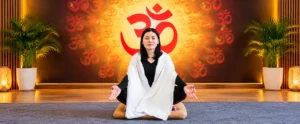
It is traditionally used as a simple meditation practice in many spiritual teachings and yoga teacher training programs in Rishikesh. Begin by sitting comfortably in a meditative posture, such as lotus pose (Padmasana) or ease pose (Sukhasana). Close your eyes, take a deep breath and slowly exhale while chanting AUM gently.
Do not rush the sound. Feel its vibration and allow your attention to rest on it. In yogic understanding, AUM represents the timeless reality behind both the manifested and un-manifested existence—without a beginning or an end. Start with a few minutes of practice and gradually increase the duration. If thoughts arise, do not fight or suppress them.
Simply return your attention to the sound and vibration of AUM. Practice with the natural absorption of a child deeply engaged in play, who forgets everything else around them. Gradually, external sounds and wandering thoughts become less important, while the sound and vibration of AUM remain at the axis of your awareness.
WORKS ON MANY LEVELS
Chanting of primordial sound reduces mental restlessness and make the mind calmer and more focused. It refines attention, emotional resilience, relaxation, and autonomic nervous system activity. For a student, this is beneficial as daily chanting of “aum” makes his study more settled and less distracted. With regular study and commitment, aum chanting can makes complex subjects easier to understand and absorb with clarity.
Whenever you feel fearful, low, or uncertain, make a habit of chanting AUM silently within, with devotion and faith. Many struggles become heavier through the mind’s own thoughts and fears. Turning inward through this sacred sound may help calm the mind, restore steadiness and bring a clearer perspective.
The inner resonance is much more than a sacred chant. It is a traditional meditation practice that connects breath, vibration, silence, and awareness into one continuous experience. Whether approached through traditional yoga practice or meditation, chanting this mantra with mindfulness can cultivate inner calm, mental clarity, and a deeper connection with oneself and existence.


What is Pranayama?
Everyone breathes, just as everyone has legs. But having legs is not the same as walking, and breathing is not the same as practicing pranayama.

What is AUM?
Sound is present everywhere: in the rhythm of your breath and heartbeat; and in the movement of the sea, air and earth.

Asanas for Diabetes
Regular asana practice can be a simple, accessible and practical way in managing diabetes. It requires no special place; you can practice them at home
What is Breath Meditation?
Of all the objects available for meditation; breath is most accessible object because it is always with you.